Carbide Tipped Router Bit Sharpening
Industrial Blade Sharpening
Industrial blade sharpening is a precision reconditioning process that restores cutting edge geometry on carbide-tipped saw blades, router bits, moulder knives, and cold saw blades used in woodworking, metalworking, and plastics manufacturing. The process belongs to the broader category of industrial tooling maintenance services, operating as a cost-reduction alternative to full blade replacement. Certified sharpening technicians use CBN and diamond grinding wheels to restore tooth geometry, hook angles, and edge tolerances to original manufacturer specifications. High-production facilities — including cabinet manufacturers, millwork plants, flooring producers, and pallet factories — depend on scheduled blade sharpening cycles to maintain cut quality, feed rate consistency, and surface finish standards. Byler Industrial Tool, Tennessee's only Freud Certified sharpener, delivers industrial blade sharpening with a 37-year combined experience base and a 100% satisfaction guarantee.
Blade Types in Industrial Sharpening
Industrial blade sharpening encompasses multiple blade categories, each defined by material composition, tooth geometry, and application. Carbide circular saw blades represent the highest-volume sharpening category, with tooth counts ranging from 24T to 120T and plate diameters from 6.5" to 16". HSS cold saw blades serve metal fabrication applications, operating at lower RPMs with finer tooth geometry than woodcutting blades. Chipper blades process wood waste streams in panel and composite manufacturing, requiring edge restoration across wide cutting faces. PCD (polycrystalline diamond) blades cut abrasive materials including fiber cement, laminate, and composite decking, and require specialized diamond grinding equipment for reconditioning. Band saw blades operate in continuous-loop configurations for resawing and contour cutting, with sharpening restoring set and tooth profile across the full blade length.
Blade sharpening restores the following measurable parameters:
- Hook angle (positive, negative, or neutral — varies by application)
- Kerf width consistency across all teeth
- Gullet depth and chip clearance geometry
- Plate tension and tracking stability
- Carbide tip face and top geometry
Cutting Tools Reconditioned by Industrial Sharpening
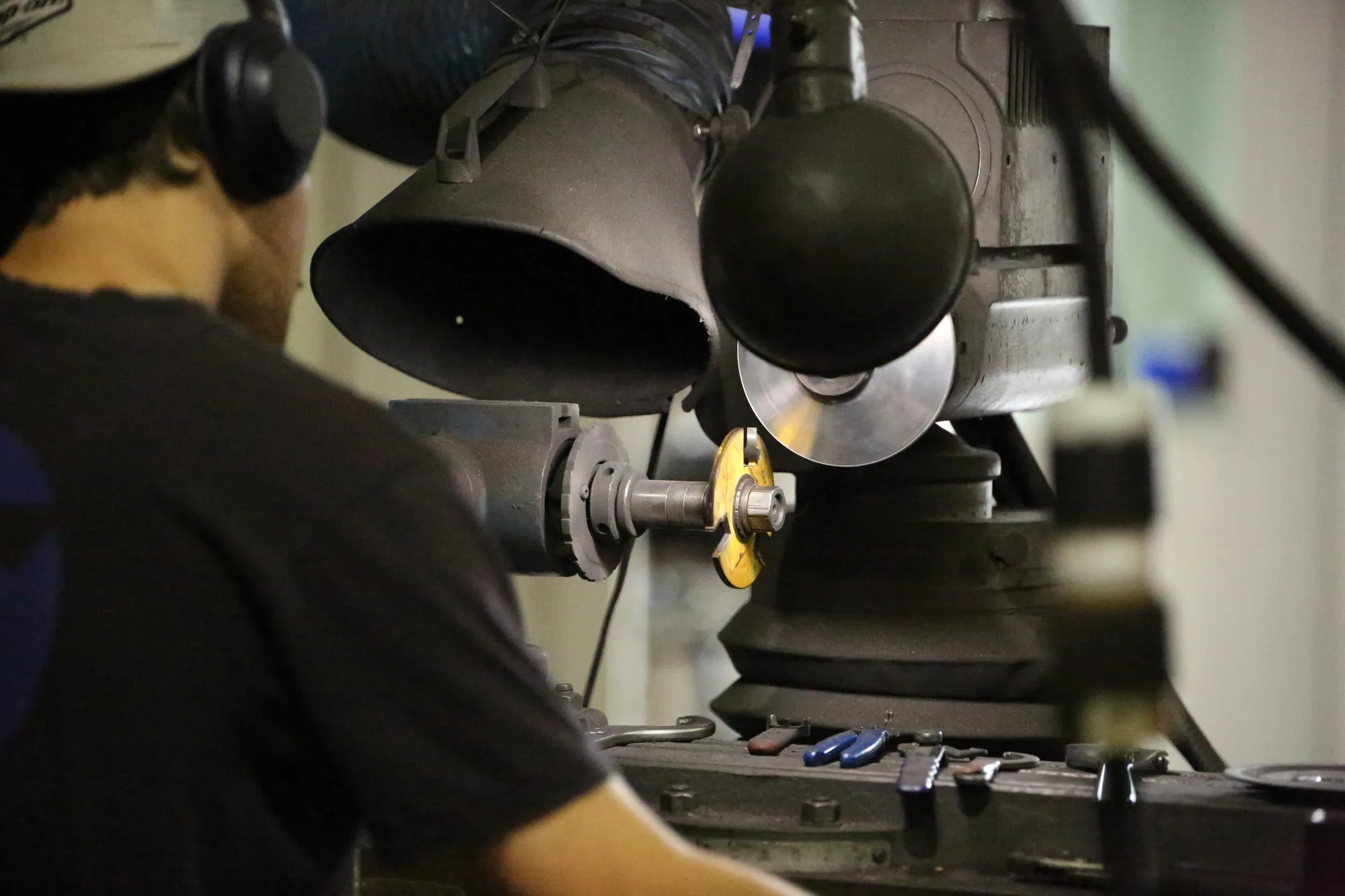
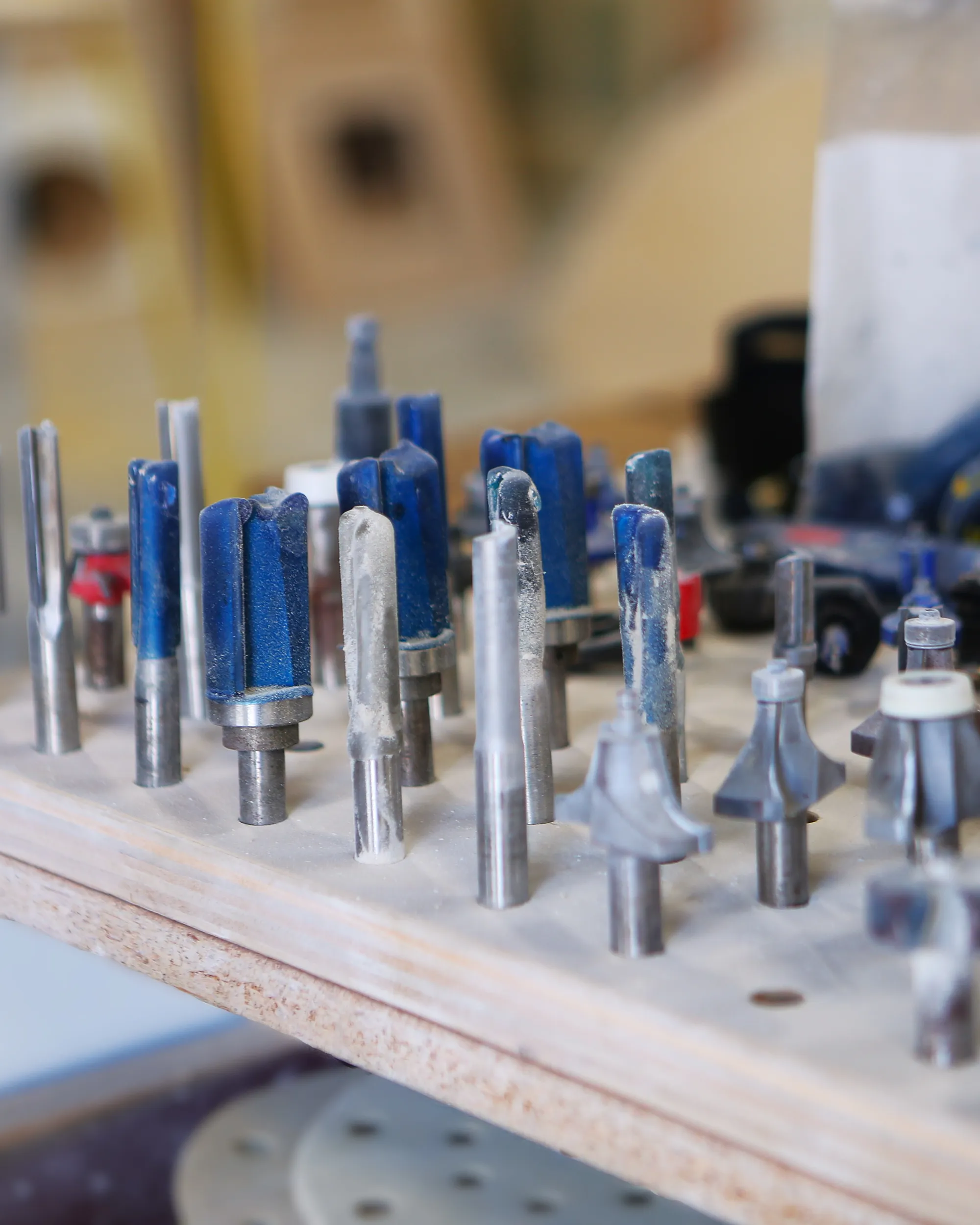
Industrial blade sharpening extends beyond circular saw blades to cover the full spectrum of rotary and profile cutting tools. Carbide-tipped router bits — including ogee, roundover, flush-trim, and dovetail profiles — are resharpened to original cutting geometry using CBN wheel grinding. Solid carbide spiral router bits and end mills require face and relief grinding to restore cutting edge sharpness without altering helix angle or flute geometry. Shaper cutters operate in furniture and millwork production, profiling edges on stiles, rails, and moulded components. Insert tooling systems use indexed carbide inserts that are rotated or replaced individually, with sharpening services extending insert life between rotation cycles. PCD tooling cuts laminate, MDF, and abrasive composites and requires diamond wheel reconditioning to restore edge integrity without fracturing the polycrystalline structure.
Profile and Custom Tooling Manufacturing
Custom profile tooling represents a distinct category within industrial blade sharpening services — one requiring both grinding precision and engineering capability. Moulder knives are ground to customer-supplied profiles or templates, producing the exact moulding cross-section required for trim, casing, baseboard, and architectural millwork. Byler Industrial Tool manufactures custom moulder knives in-house, eliminating OEM supplier lead times that typically run 4–8 weeks. Planer knives and jointer knives restore flat cutting edges to within ±0.001" tolerance, maintaining consistent stock removal across the full cutting width. Stile-and-rail cutters produce matched door frame profiles and require profile-matched grinding to maintain joint fit. Custom profile knives serve the Amish and Mennonite furniture-making community — a segment requiring unique, non-standard profiles unavailable from catalog suppliers.
The custom tooling manufacturing process follows this sequence:
- Customer submits profile template, drawing, or sample piece
- Byler grinds the knife to match the submitted profile
- Technician verifies profile accuracy against the template
- Finished knife ships within the standard 2-week turnaround
Industries Served by Industrial Blade Sharpening
Industrial blade sharpening services serve every manufacturing sector that depends on precision cutting tools for production output. Cabinet manufacturers — including suppliers to Lowe's, Home Depot, and regional distributors — run high-volume cutting operations that generate recurring blade sharpening demand on weekly or bi-weekly cycles. Millwork and moulding manufacturers produce linear footage at rates that dull carbide tips within days, requiring continuous blade rotation through sharpening cycles. Flooring producers cut hardwood, engineered wood, and laminate flooring samples on high-tooth-count blades requiring frequent reconditioning. Metal fabrication shops operate cold saw blades on ferrous and non-ferrous stock, with HSS blade sharpening extending tool life across shift-length cutting cycles. Pallet factories run high-volume ripping operations on green and reclaimed lumber — among the most demanding cutting applications for carbide blade durability.
Additional customer segments include:
- Concrete cutting contractors using cold saw and diamond blades
- German and European-owned manufacturing operations with precision tooling standards
- Large-format door manufacturers supplying national retail chains
- Amish and Mennonite woodworking and furniture production communities
- Individual craftspeople and small cabinet shops seeking professional-grade reconditioning
Service Processes in Industrial Blade Sharpening
Industrial blade sharpening follows a defined sequence of technical processes that restore cutting performance to factory specification. Carbide grinding uses CBN (cubic boron nitride) or diamond wheels — selected based on carbide grade and tip geometry — to remove the minimum material necessary to restore a sharp, true cutting edge. Hook angle correction restores the rake geometry that determines how aggressively a blade feeds through material, with positive hook angles for ripping and negative angles for crosscutting and non-ferrous metals. Plate tensioning corrects blade plate flatness and tracking stability, eliminating vibration and deflection that degrade cut quality and increase motor load. Tip re-brazing replaces carbide tips that have cracked, separated, or worn below minimum resharpening height, extending blade service life beyond the standard reconditioning cycle. Edge honing applies a final micro-bevel to the cutting edge, reducing cutting resistance and improving surface finish quality on the first post-sharpening cut.
Industrial Blade Sharpening Extends Tool Life And Reduces Replacement Costs
Industrial blade sharpening reduces total tooling cost by delivering 8–15 reconditioning cycles from a single carbide-tipped blade before plate retirement. A premium carbide saw blade priced at $200–$600 generates $1,600–$9,000 in replacement cost avoidance over its sharpened service life. With carbide tip material costs up 400% in recent years, the economic case for professional sharpening over blade replacement strengthens with every procurement cycle. Sharpening costs run 10–20% of new blade cost per cycle, producing a cost-per-cut reduction that compounds across high-volume production environments. Cabinet manufacturers, flooring producers, and millwork plants operating multiple blades simultaneously amplify these savings across their full tooling inventory.
Carbide-Tipped Blades Sharpened By Certified Technicians Deliver More Re-Sharpenings
Certification matters in industrial blade sharpening because grinding precision determines how much carbide remains after each reconditioning cycle. Non-specialist sharpeners remove excess carbide per pass — accelerating tip wear and reducing the total number of sharpenings a blade supports. Byler Industrial Tool operates as Tennessee's only Freud Certified sharpener, meeting manufacturer-specified grinding parameters for Freud blades and applying equivalent precision standards to all other blade brands. CBN wheel grinding preserves 20–30% more carbide per sharpening pass than conventional abrasive wheels, directly extending re-sharpenable blade life. A blade sharpened eight times by a certified technician delivers more total cutting performance than a blade replaced twice at full price.
Mail-In Sharpening Services Enable Nationwide Access To Precision Reconditioning
Byler Industrial Tool's mail-in sharpening service delivers precision reconditioning to manufacturers in all 50 states within a 2-week turnaround window. Customers pack and ship blades, router bits, and moulder knives directly to Byler's middle Tennessee facility using standard freight or parcel carriers. The 2-week turnaround applies regardless of customer location — orders from California, Washington State, and the Southeast receive identical service windows. Manufacturers operating blade par inventory — maintaining a rotating set of spare blades — experience zero production downtime during the mail-in reconditioning cycle. Byler provides a customer sharpening order form to streamline intake, specify service requirements, and confirm return shipping instructions before tools leave the customer facility.
Custom Moulder Knife Manufacturing Eliminates OEM Lead Times
Custom moulder knife manufacturing at Byler Industrial Tool replaces the 4–8 week OEM supplier lead time with in-house grinding and profile matching. Customers submit a profile template, sample moulding piece, or engineering drawing — Byler grinds the knife to match within ±0.001" tolerance. HSS M2, M42, and carbide-tipped steel grades cover the full range of production requirements, from short custom runs to high-volume continuous moulding operations. Profile complexity — including radius combinations, cove-and-bead combinations, and architectural crown profiles — presents no production constraint at Byler's facility. Amish and Mennonite furniture makers represent a significant custom knife customer segment, sourcing non-catalog profiles that standard tooling suppliers do not stock.
Industrial Sharpening Services Deliver Higher Margins Than Product Sales
Industrial blade sharpening generates higher profit per job than product sales because the service model carries no inventory overhead, no freight-in cost, and no SKU management burden. A sharpening technician producing reconditioned blades generates revenue from labor and equipment — fixed costs that do not scale with job volume. Product sales, by contrast, require capital tied up in inventory, warehouse space, freight logistics, and the risk of slow-moving SKUs across a catalog of 30,000+ items. Sharpening revenue scales with shop capacity and shift utilization — Byler currently operates one shift, five days per week, with capacity to absorb additional volume without capital expenditure. The sharpening service model also generates recurring customer relationships, as blades return on predictable cycles rather than one-time purchase events.
Frequently Asked Questions
How Many Times Can A Carbide Saw Blade Be Sharpened?
Carbide-tipped saw blades support 8–15 sharpenings under professional reconditioning before plate retirement. The count depends on carbide grade, tooth geometry, material cut, and grinding method. CBN wheel grinding preserves 20–30% more carbide per pass than abrasive wheels, extending re-sharpenable life measurably across the blade's service cycle.
What Is The Turnaround Time For Industrial Blade Sharpening?
Byler Industrial Tool operates a 2-week standard turnaround for all mail-in sharpening orders. The turnaround applies to customers in all 50 states. Manufacturers maintaining blade par inventory — spare blades in active rotation — experience no production downtime during the reconditioning window.
Is It Cheaper To Sharpen Or Replace Industrial Saw Blades?
Sharpening costs 10–20% of new blade cost per cycle. A $200–$600 carbide blade sharpened 8–15 times generates $1,600–$9,000 in replacement cost avoidance over its service life. With carbide material costs up 400% in recent years, sharpening delivers the highest ROI in the tool's history.
What Industries Benefit Most From Professional Blade Sharpening?
Cabinet manufacturing, millwork production, flooring manufacturing, metal fabrication, and pallet production generate the highest industrial blade sharpening volume. High-production operations supplying Lowe's, Home Depot, and regional distributors run recurring sharpening cycles on weekly or bi-weekly schedules.
Can Router Bits And Moulder Knives Be Sharpened To Original Spec?
Yes. Carbide-tipped and solid carbide router bits are resharpened to original cutting geometry using CBN and diamond wheels. Custom moulder knives are ground to customer-supplied templates or drawings, restoring or exceeding original profile spec. Byler Industrial Tool manufactures custom profile moulder knives in-house.
Common Misconceptions About Industrial Blade Sharpening
Misconception: All Blade Sharpening Services Produce The Same Results
Sharpening quality depends on equipment precision, technician certification, and grinding method. Certified sharpeners using CNC-controlled CBN wheels hold tighter tolerances than general-purpose shops, delivering measurably better cut quality and longer edge retention per reconditioning cycle.
Misconception: Carbide Blades Cannot Be Sharpened More Than Two Or Three Times
Carbide-tipped blades support 8–15 sharpenings under professional reconditioning. This error originates from low-quality sharpening that removes excessive carbide per pass. Precision grinding restores edge geometry by removing only the minimum material required — preserving tip volume across the full service life.
Misconception: Industrial Sharpening Is Only Cost-Effective For Large Production Shops
Small cabinet shops, custom furniture makers, and individual craftspeople achieve measurable cost savings from professional sharpening. A single precision-sharpened blade outperforms multiple cheap replacements on cut quality, feed rate consistency, and surface finish — at lower total cost per linear foot of material processed.
Misconception: Mail-In Blade Sharpening Services Are Slower Than Local Options
A 2-week mail-in turnaround matches or beats many local sharpening shops. Manufacturers operating blade par inventory experience zero production downtime during the mail-in cycle. Byler's Tennessee facility services all 50 states within the same 2-week window regardless of customer location.
Misconception: A Sharp-Looking Blade Does Not Need Sharpening
Carbide tip wear occurs at the microscopic level — invisible to the naked eye — before cut quality degrades. Feed rate resistance, burning on cut surfaces, and increased motor load are early performance indicators that a blade requires reconditioning, appearing before any visible tip damage is detectable.
Ongoing Debates in Industrial Blade Sharpening
CBN vs. Diamond Wheel Grinding for Carbide-Tipped Tooling
CBN wheels grind steel bodies and carbide tips efficiently but generate heat that some technicians argue degrades carbide microstructure at the grain boundary. Diamond wheel advocates counter that diamond wheels remove carbide more precisely with less heat generation on pure carbide faces. Most certified sharpening operations use both — CBN for steel and hybrid grinding, diamond for pure carbide faces — selecting wheel type by application.
CNC Automated Sharpening vs. Manual Hand-Grinding on Complex Profiles
CNC sharpening machines (Vollmer, Anca, Walter) hold tighter geometric tolerances on standard tooth profiles but require significant programming time for non-standard profiles. Manual grinding allows experienced technicians to adapt to complex or irregular profiles that automated systems cannot accommodate without custom fixturing. The debate centers on whether consistency or adaptability produces better outcomes for specialty tooling.
Scheduled Maintenance Intervals vs. Performance-Triggered Resharpening
Scheduled sharpening — replacing blades on a fixed cycle regardless of observed condition — reduces the risk of running a degraded blade into production. Performance-triggered resharpening waits for measurable indicators (feed resistance, surface burn, increased motor amperage) before pulling a blade. Scheduled maintenance advocates argue that degraded blades consume more energy and produce more scrap before they are pulled — costs that exceed the price of one additional sharpening cycle.
In-House Sharpening Equipment vs. Outsourced Industrial Sharpening Services
Mid-size shops periodically evaluate whether purchasing in-house sharpening equipment — costing $20,000–$150,000 for a capable CBN grinder — produces a better ROI than outsourcing. The outsourcing argument centers on technician expertise, equipment maintenance cost, and the absence of capital outlay. The in-house argument centers on turnaround speed and control. Most shops below 10,000 blade-sharpenings per year find outsourcing more cost-effective.
PCD Tooling vs. Carbide-Tipped Tooling for High-Volume Abrasive Material Cutting
PCD (polycrystalline diamond) tooling outperforms carbide in edge retention on abrasive materials — laminate, fiber cement, MDF, and composite decking — delivering 50–100x longer run times between sharpenings. The debate is economic: PCD tooling costs 5–10x more than carbide equivalents, and PCD sharpening requires specialized diamond grinding equipment unavailable at most sharpening shops. Carbide advocates argue that the lower acquisition cost and wider sharpening availability offset the run-time advantage for mid-volume operations.
Components of Industrial Blade Sharpening
Industrial blade sharpening operates on five functional components that together determine reconditioning quality and tool performance after service. The carbide tip — brazed to the blade plate at each tooth — is the primary cutting element ground during sharpening; its volume, grade, and bond integrity determine how many reconditioning cycles a blade supports. The tooth gullet — the curved relief between teeth — controls chip evacuation during cutting; sharpening restores gullet geometry to prevent chip packing that causes heat buildup and blade deflection. The shank on router bits and end mills connects the cutting head to the machine spindle; sharpening services preserve shank diameter and concentricity to maintain runout specifications. The cutting edge itself — measured in microns of edge radius — defines surface finish quality on the first post-sharpening cut; precision grinding followed by honing delivers the tightest achievable edge radius. The sharpening cycle, as a process component, fits within the total tooling lifecycle cost model — each cycle's cost divided by the cutting performance it restores determines the true cost-per-cut for any industrial blade.
Summary
Industrial blade sharpening is a precision manufacturing service that restores carbide-tipped saw blades, router bits, moulder knives, cold saw blades, and profile cutting tools to original cutting specification. The service spans five core industries — cabinet manufacturing, millwork production, flooring, metal fabrication, and pallet production — and delivers 8–15 reconditioning cycles per blade at 10–20% of replacement cost. Mail-in service with a 2-week turnaround makes professional-grade reconditioning accessible to manufacturers in all 50 states. Custom moulder knife manufacturing extends the service model beyond sharpening into profile tooling production. Byler Industrial Tool, Tennessee's only Freud Certified sharpener, delivers industrial blade sharpening with 37 years of combined technician experience and a 100% satisfaction guarantee.
A router bit drawer is a woodworker’s best friend—until those bits become dull and unreliable, that is. Too often, woodworkers send their router bits off for sharpening, only to need additional sharpening a short time later. That’s simply unacceptable for anyone, especially for business owners who run high-volume facilities.
Trust Our Experience And Our Expertise
Byler Industrial Tool believes in getting the job done right the first time—and that’s why we offer a 100 percent unconditional performance guarantee. That means we guarantee the carbide tipped router bit you send us will come back to you with longer run times between service, better cut quality, and overall greater sharpness compared to what you’ll get from traditional sharpening methods.
We Know the Value of a Sharp Router Bit
Your router bit is one of the most important pieces of equipment in your shop, regardless of the scale of your business. Because of its importance for woodworkers, improperly serviced and poorly sharpened router bits can result in serious downtime and additional work, cutting into your profits and leading to major headaches.
As with all parts that we service, we give every router bit that enters our shop the attention it deserves.
Contact us today at (615)763-6227.
- We start with a thorough cleaning and inspection process that includes replacing worn out bearings.
- Then, we carefully regrind the bit while ensuring maximum shape accuracy.
- Only after ensuring that every aspect of the bit meets our strict quality standards do we begin the careful packaging and shipping process to get the bit back in your hands as soon as possible.
Improved Router Bits Means Improved Sharpening Processes
The march of progress and technological improvement never stop, and to better serve our customers, we never stop learning about the latest advancements in the industry. New carbide tipped router bits are barely recognizable compared to their older counterparts due to innovations and improvements that can include:
- Additional wings
- Special coatings
- Shear angles
- Opposing sheers
- Hi-density (nano-grained) carbide formulations
These advancements require knowledge and specialized tools to preserve and maintain—and we have both. Byler Industrial Tool is a Freud Authorized Service Center, and that means you can trust our experience, expertise, and cutting-edge equipment if you need a sharpened router bit.