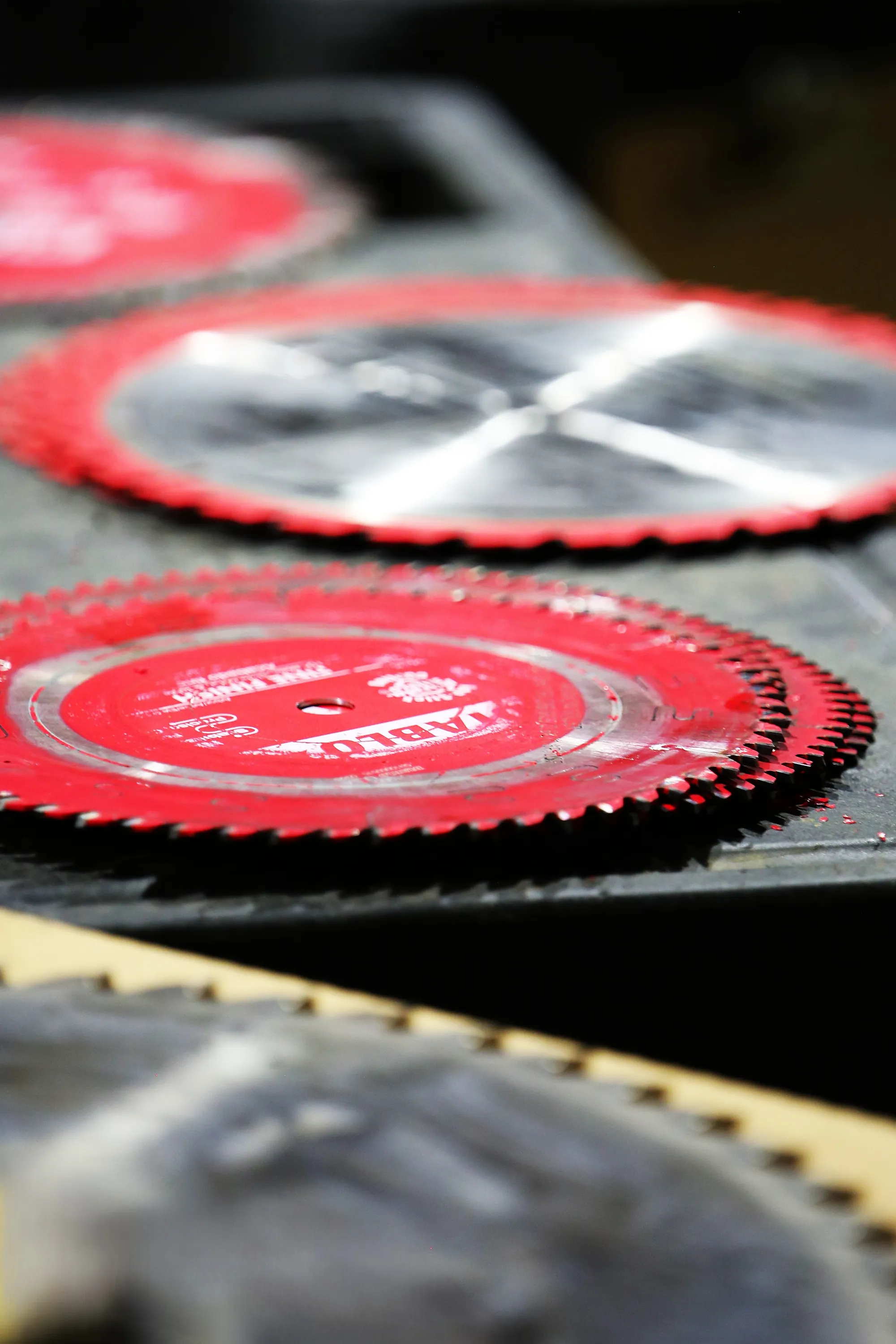
Clarksville TN Saw Blade Sharpening
Stop replacing carbide saw blades you could sharpen 8–15 more times.
Byler Industrial Tool provides mail-in carbide circular saw blade sharpening to factory spec for Clarksville, TN cabinet, millwork, flooring, pallet, and metal fabrication shops — ship from Clarksville and get it back in 2 weeks.
10–20% of new-blade cost per cycle · $25 minimum order · Free shop audit
- 27 miles from Erin — ~35 min drive, or any carrier
- 8–15 sharpenings — per blade before plate retirement
- CBN grinding — preserves 20–30% more carbide per pass
- 2-week turnaround — any carrier, all 50 states
- Freud Certified — technicians restore factory geometry
Serving Clarksville, TN shops from Erin, Tennessee, 27 miles away.
Carbide Circular Saw Blade Sharpening for Clarksville, TN
Distance and transit
Clarksville, TN is 27 miles (~35 min by road) from Byler's Erin, Tennessee facility. Ship by any carrier and the standard turnaround on mail-in orders is 2 weeks. Byler returns orders by UPS Ground, prepaid and added to your invoice, unless you supply your own UPS or FedEx account number. At this distance you can also bring tooling to the Erin facility directly (Mon-Fri, 8:00 AM - 5:00 PM).
Industrial areas and major plants around Clarksville
- Clarksville-Montgomery County Corporate Business Park — Industrial Development Board-owned park zoned M-2 Industrial; Bridgestone Metalpha USA (steel cord) is in the park. Northern section marketed with 1,100+ acres next to the Google data center
- Corporate Business Park South — 75-acre Select Tennessee certified site (69 developable acres listed by TNECD)
The local industry
Trane US (air conditioning/heating units), Hankook Tire (auto tires), LG (small electrical appliances) and Hendrickson (trailer air-ride suspensions) are listed by MTIDA (2026)
Orgain Building Supply Co. makes wooden trusses (96 employees); Florim USA makes ceramic/porcelain tile (2026)
Nyrstar (primary zinc smelter), Bridgestone Metalpha (steel cord) and Graphic Packaging International (plastic cups); Montgomery County manufacturing averaged 6,767 employees in 2024
Metal fabrication operations also send carbide circular saw blades to Byler for reconditioning to original manufacturer geometry.
How It Works for Clarksville
Ship From Clarksville
Clarksville is 27 miles (~35 min) from the Erin, TN facility. Pack your tooling and ship by any carrier.
We Restore It to Spec
Freud Certified technicians restore your tooling to original manufacturer specification.
Back in Production
Tooling returns within 2 weeks, sharp, verified, and backed by Byler's 100% satisfaction guarantee.
Carbide Circular Saw Blade Sharpening Pricing
| New carbide blade | $200–$600 |
|---|---|
| Sharpening cost per cycle | 10–20% of new-blade cost |
| Sharpenings per blade | 8–15 |
| Replacement cost avoided | $1,600–$9,000 per blade over its service life |
- $25 minimum order on Byler's sharpening order form
- Returned by UPS Ground, prepaid and added to your invoice, unless you supply your own UPS or FedEx account number
- Payment: credit card or purchase order
- Free shop audit & cost savings analysis for production shops
- 2-week standard turnaround on mail-in orders, all 50 states
What the order form asks for on each item:
- Quantity of each item
- Diameter (saw blades) or diameter and length (bits, cutters, knives)
- Description: tooth count and brand for saw blades; flutes or wings and knives per set for bits and knives
Clarksville shops: stop replacing tooling Byler can restore. Request a quote today.
Request a QuoteCarbide Circular Saw Blade Sharpening in Clarksville, TN — Local Questions
How far is Clarksville, TN from Byler, and how do shops there get tooling to Erin?
Clarksville, TN is 27 miles (~35 min by road) from Byler's Erin, Tennessee facility. Ship by any carrier; the standard turnaround on mail-in orders is 2 weeks, and it applies in all 50 states. Direct drop-off at the Erin facility is also possible.
Can shops at Clarksville-Montgomery County Corporate Business Park use Byler?
Yes. Byler serves production shops in all 50 states by mail, so a shop at Clarksville-Montgomery County Corporate Business Park ships to the Erin, Tennessee facility the same way any other customer does. Ask about Byler's free shop audit and cost savings analysis at (615) 763-6227.
How does carbide circular saw blade sharpening fit the industries around Clarksville, TN?
Trane US (air conditioning/heating units), Hankook Tire (auto tires), LG (small electrical appliances) and Hendrickson (trailer air-ride suspensions) are listed by MTIDA (2026). Metal fabrication operations also send carbide circular saw blades to Byler for reconditioning to original manufacturer geometry.
Byler Industrial Tool Guarantee
Every blade, bit, and knife Byler sharpens ships with a 100% satisfaction guarantee. If your tooling does not perform to specification after reconditioning, Byler resolves the issue — no debate, no delay. That guarantee applies to every job, every brand, and every customer regardless of location.
Also Serving Nearby Communities
Cities We Serve — Carbide Circular Saw Blade Sharpening
Tennessee
Middle Tennessee
- Nashville TN Carbide Circular Saw Blade Sharpening
- Murfreesboro TN Carbide Circular Saw Blade Sharpening
- Franklin TN Carbide Circular Saw Blade Sharpening
- Columbia TN Carbide Circular Saw Blade Sharpening
- Cookeville TN Carbide Circular Saw Blade Sharpening
- Centerville TN Carbide Circular Saw Blade Sharpening
- Dickson TN Carbide Circular Saw Blade Sharpening
- Ethridge TN Carbide Circular Saw Blade Sharpening
- Fayetteville TN Carbide Circular Saw Blade Sharpening
- Hendersonville TN Carbide Circular Saw Blade Sharpening
- Hohenwald TN Carbide Circular Saw Blade Sharpening
- Lewisburg TN Carbide Circular Saw Blade Sharpening
- Lyles TN Carbide Circular Saw Blade Sharpening
- McMinnville TN Carbide Circular Saw Blade Sharpening
- Shelbyville TN Carbide Circular Saw Blade Sharpening
- Smyrna TN Carbide Circular Saw Blade Sharpening
- Sparta TN Carbide Circular Saw Blade Sharpening
- Summertown TN Carbide Circular Saw Blade Sharpening
- Tullahoma TN Carbide Circular Saw Blade Sharpening
East Tennessee
- Knoxville TN Carbide Circular Saw Blade Sharpening
- Chattanooga TN Carbide Circular Saw Blade Sharpening
- Morristown TN Carbide Circular Saw Blade Sharpening
- Bristol TN Carbide Circular Saw Blade Sharpening
- Johnson City TN Carbide Circular Saw Blade Sharpening
- Kingsport TN Carbide Circular Saw Blade Sharpening
- Cleveland TN Carbide Circular Saw Blade Sharpening
- Maryville TN Carbide Circular Saw Blade Sharpening
- Lenoir City TN Carbide Circular Saw Blade Sharpening
- Oak Ridge TN Carbide Circular Saw Blade Sharpening
Kentucky
South Central Kentucky
Western Kentucky
Louisville Metro
Bluegrass Kentucky
- Lexington KY Carbide Circular Saw Blade Sharpening
- Georgetown KY Carbide Circular Saw Blade Sharpening
- Richmond KY Carbide Circular Saw Blade Sharpening
- Danville KY Carbide Circular Saw Blade Sharpening
- Frankfort KY Carbide Circular Saw Blade Sharpening
- Columbia KY Carbide Circular Saw Blade Sharpening
North Carolina
Catawba Valley / Western NC
- Hickory NC Carbide Circular Saw Blade Sharpening
- Lenoir NC Carbide Circular Saw Blade Sharpening
- Morganton NC Carbide Circular Saw Blade Sharpening
- Newton NC Carbide Circular Saw Blade Sharpening
- Conover NC Carbide Circular Saw Blade Sharpening
- Claremont NC Carbide Circular Saw Blade Sharpening
- Yadkinville NC Carbide Circular Saw Blade Sharpening